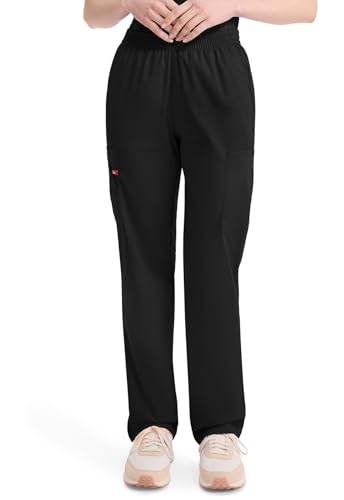
scrubpants
Read the percentages instead of the headline
Cherokee lists its CK4243 utility pant as 55 percent cotton, 42 percent polyester, and 3 percent spandex, with two-way stretch. FIGS lists FIONx as 72 percent polyester, 21 percent rayon, and 7 percent spandex. These examples show why a broad label such as “cotton scrubs” leaves out useful information.
Write down the entire composition for the specific pant and color you are considering. Check whether the waistband or cuffs use a separate material. A comfortable stretch waistband does not tell you how freely the main leg fabric will move.
Do not reduce comfort to a fiber contest
Consider construction, thickness, surface feel, and fit alongside composition. CottonWorks describes ways to alter cotton’s moisture handling through yarn treatment and fabric design. Its technology guidance is a reminder that a fiber name alone does not specify the performance of every finished fabric.
That does not mean a particular scrub pant uses a named textile technology. Require the manufacturer to identify it on that product before attributing the feature to the garment. The same caution applies when a listing describes a fabric as cooling, technical, or performance.
For your own comparison, identify what you dislike in your current pair. Is it a stiff thigh, a warm waistband, a damp feeling, a scratchy seam, or too much fabric around the legs? Those are different buying problems. A change in cut or construction may help more than switching the largest fiber percentage.
Use a fitting-room comparison that answers your question
Try similar silhouettes and the same intended size range so that an obviously loose pant does not win a comfort comparison simply because it has more room. Sit for a few minutes, bend your knees, and take normal walking steps. Check pocket outlines and whether the seat fabric becomes overly stretched.
Handle the fabric at the calf and at the thickest part of the waistband. Notice whether you prefer a crisp surface or a softer drape. These are preferences worth recording; they are not laboratory measurements of breathability or durability.
If ordering online, avoid buying a full rotation before one pair has proved suitable. Keep its model and fabric name in your notes so you can reorder accurately rather than relying on the brand alone.
Let your laundry routine break the tie
Compare the care labels before paying. Can the pants use the approved workplace laundry process? Can you complete the specified drying method between shifts? Do you have time for any pressing that the look requires?
Shrinkage also cannot be assigned from cotton percentage alone. CottonWorks identifies construction, processing, and garment care as relevant to dimensional stability. Measure a new pair and assess it after the instructed wash rather than sizing up automatically.
When both options fit, choose the one that feels comfortable and works with your real care schedule. A carefully selected blend that you can wash, dry, and wear consistently is a stronger purchase than a supposedly superior fiber in pants you avoid wearing.